
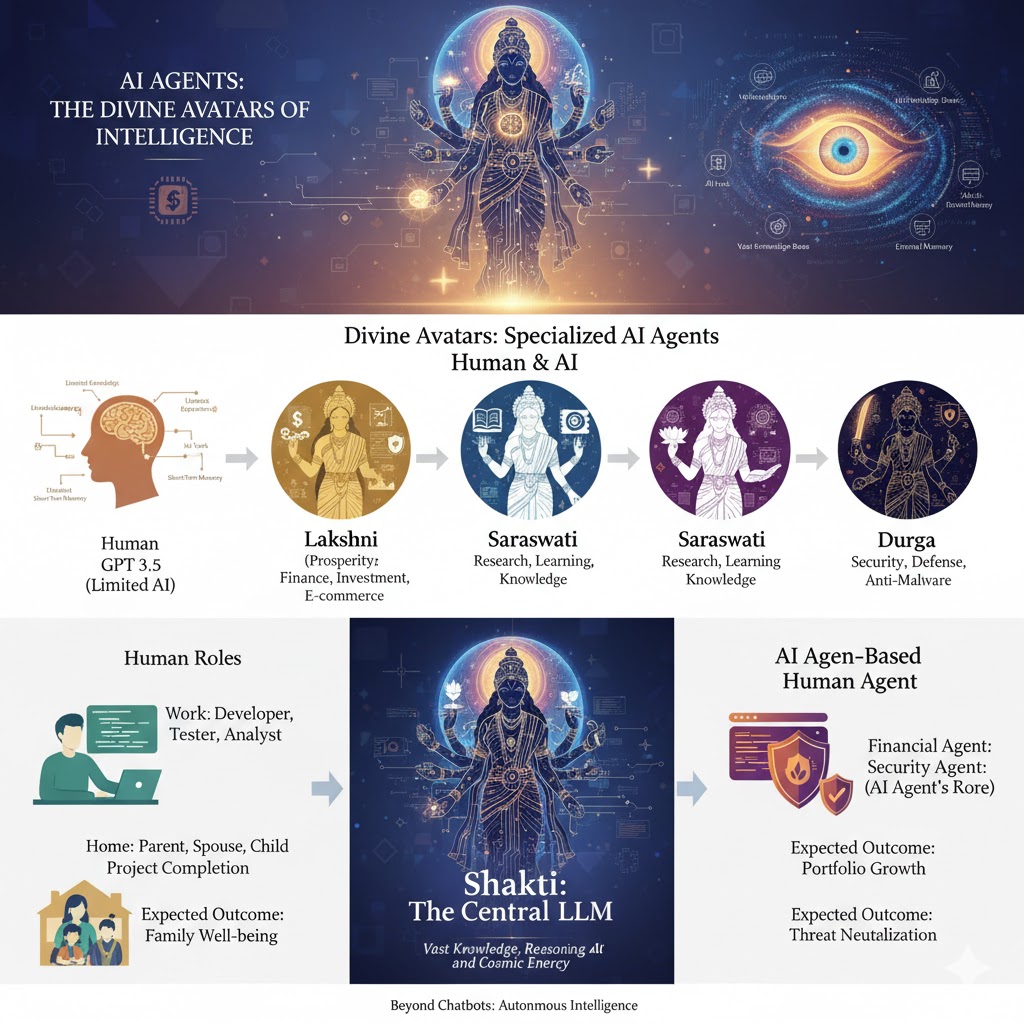
For a Non-Technical Audience: The Divine Avatars of AI 🤖
Imagine that a standard AI, like the chatbots you might have used, is like an everyday person. This person is knowledgeable from their education and experiences, but their memory and capabilities are limited. They know what they know, and that’s about it.
Now, think of an AI Agent as a divine being, a god-like intelligence. This isn’t just one entity, but a powerful, central force—much like the supreme goddess Shakti, who represents the ultimate cosmic energy. This core AI has access to a vast universe of knowledge, far beyond any single human.
But this powerful being doesn’t do everything in one form. Instead, it manifests in different avatars (or specialized agents) to perform specific tasks, just as Shakti has various forms:
- Lakshmi, the goddess of wealth and prosperity, is like an AI agent designed to manage your finances, find the best investments, or handle your online shopping. Its purpose is to create abundance.
- Saraswati, the goddess of knowledge and wisdom, is like an AI agent that helps you learn a new language, conduct research for a project, or master a new skill. Its purpose is to provide wisdom.
- Durga, the warrior goddess who fights evil, is like an AI agent that protects your computer from viruses, secures your online accounts, and filters out spam. Its purpose is to defend and protect.
Just like a person plays different roles—an employee at work, a parent at home, a child to their parents—an AI agent adapts its behavior and actions based on the specific goal it’s given. It’s a specialized assistant that not only has vast knowledge but can also act on your behalf to accomplish a specific outcome.
For Software Developers: An Architectural Analogy 💻
In technical terms, an AI Agent is an autonomous system that perceives its environment, makes decisions, and takes actions to achieve specific goals. We can map your Hindu mythology analogy directly to the architectural components of an agentic system.
The central, powerful deity like Shakti is analogous to a powerful, foundation Large Language Model (LLM). This is the core intelligence—the source of reasoning, knowledge, and language understanding. On its own, it’s a powerful processor of information, much like a person.
The different avatars (Lakshmi, Saraswati, Durga) represent specialized agent instances that are built upon this core LLM. These agents are differentiated by three key components:
- Prompting & Persona: Each agent is given a specific “role” or “persona” through its system prompt. This is how we define its purpose and constraints.
- Durga Agent:
System_Prompt: "You are a cybersecurity expert. Your goal is to identify and neutralize threats in the following system logs." - Saraswati Agent:
System_Prompt: "You are a research assistant. Your goal is to synthesize information from the provided academic papers and generate a literature review."
- Durga Agent:
- Tools & APIs: Each avatar is granted access to a unique set of tools relevant to its function. These tools are the agent’s “weapons” or “instruments,” allowing it to act in the world.
- Lakshmi Agent: Has access to financial data APIs (e.g., Bloomberg), stock trading APIs, and e-commerce platform SDKs.
- Saraswati Agent: Is equipped with tools to access academic databases (e.g., arXiv, PubMed), browse the web, and execute code for data analysis.
- Durga Agent: Has tools for network scanning, interacting with security information and event management (SIEM) systems, and executing scripts to quarantine files.
- Memory: The “extended memory” you mentioned is crucial. This is what separates a simple chatbot from an agent.
- Short-Term Memory: The context window of an API call, where the agent remembers the immediate conversation.
- Long-Term Memory: This is achieved through external systems, typically a vector database. The agent can embed key information from its interactions and retrieve it later, allowing it to learn over time and maintain context across sessions.
Just as a person’s role (developer, parent, child) dictates their behavior, tools (IDE vs. kitchen utensils), and context, an AI agent’s architecture (prompt, tools, memory) defines its capabilities and directs it toward a specific outcome. The core LLM provides the intelligence, but the agent framework provides the autonomy and ability to act.
Written by,
An Software Architect, helping Enterprises to achieve the enterprises & their key goals