Marketing is undergoing a structural shift: from campaign-centric broadcasting to decision-centric engagement. Instead of designing messages and hoping customers respond, modern organizations must sense, interpret, and respond to customer intent in real time.
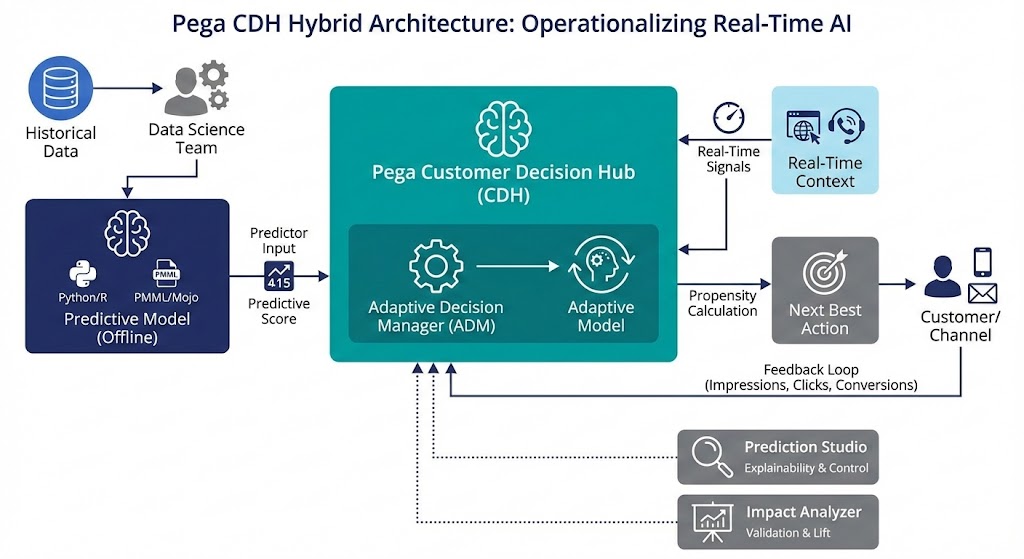
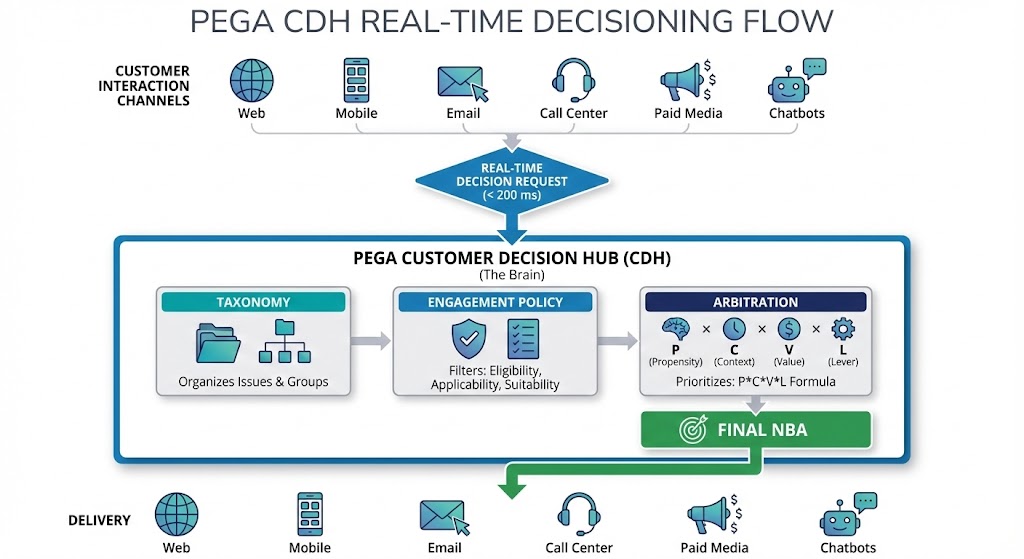
Pega Customer Decision Hub (CDH) enables this evolution by acting as the centralized “decisioning brain” that determines a Next Best Action (NBA) for each individual—based on both strategic priorities and live customer behavior.
The Center-out™ Brain
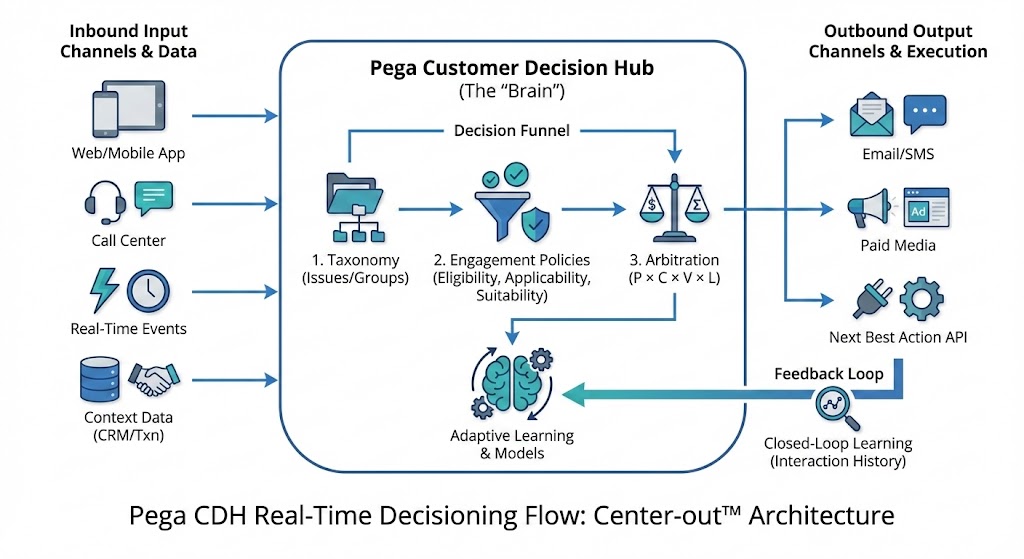
Unlike traditional top-down or channel-first architectures, Center-out™ begins where value is created:
at the moment of customer interaction.
The pattern places the decisioning intelligence CDH – at the center of the architecture. Channels (web, email, mobile, CRM) become execution layers, not logic owners. This prevents siloed experiences and ensures every touchpoint (including monthly newsletters) is informed by the same unified understanding of the customer.
The Core Components of CDH
1. Taxonomy – Structuring the Decisioning Landscape
The Taxonomy organizes all possible actions into:
- Issues: High-level business objectives
(e.g., “Engagement,” “Treasury Insights”) - Groups: Subcategories
(e.g., “Liquidity Articles,” “Cashflow Automation Guides”)
In our commercial banking context, newsletter articles become Actions under a Thought Leadership Issue.
Strategic Insight — Why it Matters
For CMOs: Ensures consistent messaging structure across channels.
For LDAs: Provides a scalable object model for orchestrating thousands of actions.
2. Engagement Policy – Applying the Guardrails
Not all content fits every commercial contact.
Engagement Policies filter actions based on:
- Eligibility: Is this contact valid for this action?
(e.g., ensure de-duplicated, correct commercial contact record.) - Applicability: Is this relevant now?
(e.g., avoid re-suggesting an article already consumed.) - Suitability: Is this ethical and appropriate?
(e.g., avoid promoting high-risk treasury products to smaller partners.)
Strategic Insight – Why it Matters
For CMOs: Maintains trust and avoids tone-deaf communication.
For LDAs: Removes noise, ensuring only viable actions reach the scoring stage.
3. Arbitration – Selecting the Optimal Action
Once actions pass the Engagement Policies, CDH must determine which one is best for the customer right now.
This is handled by the Arbitration formula:
Priority= P × C × V × L
Where:
- P — Propensity: AI-predicted likelihood of engagement
- C — Context Weighting: Importance of the current touchpoint
- V — Business Value: Strategic or revenue-driven weight
- L — Levers: Manual boosts for priority topics
Strategic Insight – Why it Matters
For CMOs: Your communications become smarter every month.
For LDAs: Propensity and context models improve automatically without rule rewrites.
4. Channels – Delivering the Decision
Channels are the execution layer for the brain’s decisions.
In this scenario, the Email Newsletter is the outbound delivery mechanism.
CDH selects the top article set → passes it to the communication layer → content is personalized for each commercial contact.
Strategic Insight – Why it Matters
For CMOs: Every email becomes dynamically tailored.
For LDAs: Channel logic stays light; the brain handles intelligence.
Real-World Application: The “Content Live” Feedback Loop
To understand the power of this architecture, let’s trace the lifecycle of a Commercial Banking Newsletter.
- The Trigger: The CRM system initiates the monthly newsletter generation for “Global Logistics Partners.”
- The Decision: CDH filters actions. The Engagement Policy removes a “New Account” offer because the client just opened one last week.
- The Arbitration ($P \times V$):
- The Input: The system sees data from Content Live. Two weeks ago, this contact clicked on an article about “Supply Chain Resilience.”
- The Calculation: This click data feeds the Adaptive Models. Consequently, the Propensity ($P$) score for “Supply Chain Financing” offers spikes.
- The Result: Even though the Bank wants to push “Credit Cards” ($V$), the high Propensity ($P$) for “Supply Chain” wins the Arbitration formula.
- The Outcome: The newsletter is generated featuring the “Supply Chain Financing” article.
- Closed-Loop Learning: If the partner clicks this link, Content Live captures the interaction and feeds it back to CDH, further training the model for the next interaction.
Closing Insights
The architecture of Pega CDH is designed for speed and agility. By separating the logic (Taxonomy/Engagement) from the math (Arbitration/Adaptive Models), the system allows Marketing Analysts to adjust strategies without needing IT to rewrite code.
For the enterprise, this means achieving the “Holy Grail”: a self-optimizing feedback loop that learns from every click, ensuring that the decision made in milliseconds.