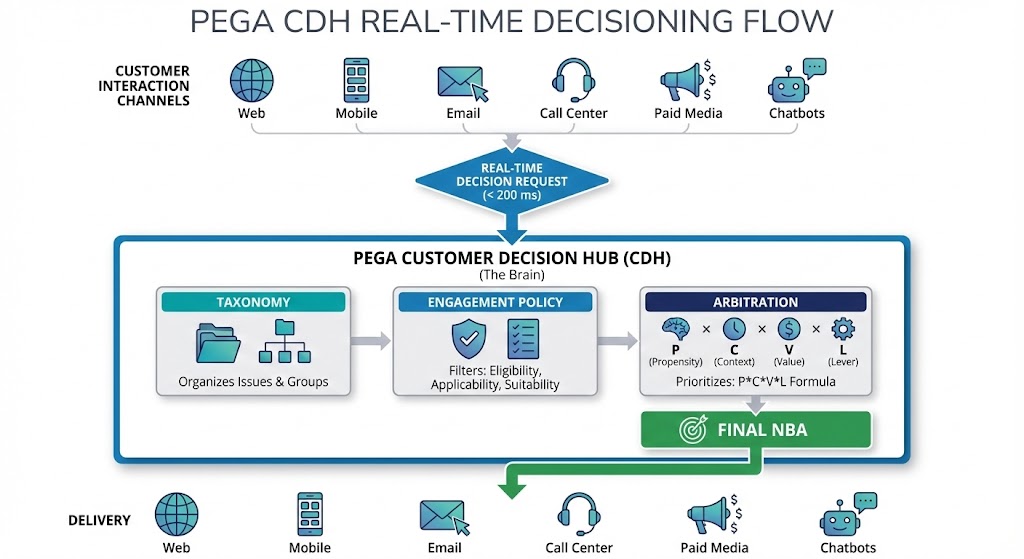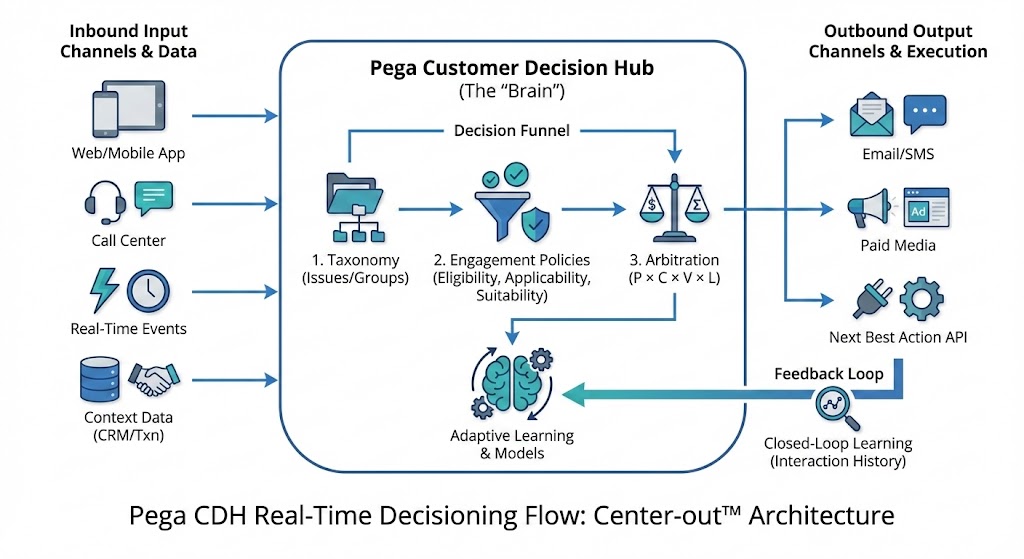
In the enterprise MarTech landscape, a critical friction point exists between the Data Science team’s desire for model precision and the Business’s need for real-time agility. The Data Science team builds robust predictive models offline, optimized for accuracy on historical data. However, customer intent changes in milliseconds, often rendering static models obsolete by the time they are deployed.
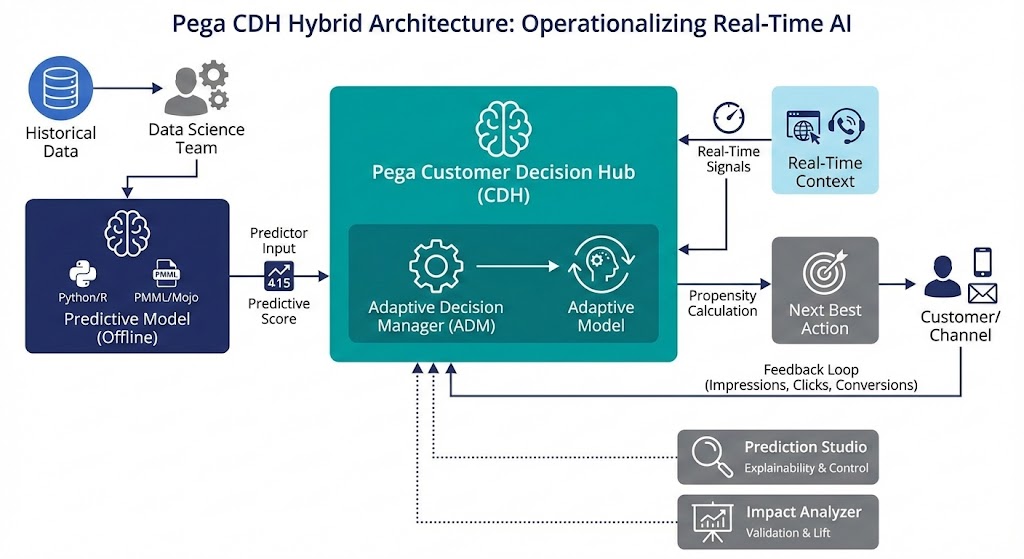
Pega Customer Decision Hub (CDH) resolves this through a hybrid architecture. It does not replace the work of the Data Science team; it operationalizes it. By layering Adaptive Models (online learning) over Predictive Models (offline propensity), organizations create a Center-out™ brain that learns in the moment while respecting historical intelligence.
This article details the architectural distinction between these model types and outlines a governance framework to address the “Black Box” concerns often raised by Lead Decision Architects (LDAs) and Data Scientists.
1. The Architectural Split: Predictive vs. Adaptive
To maximize decisioning power, one must distinguish between the “Anchor” (Predictive) and the “Compass” (Adaptive).
The Predictive Model: The Anchor
Predictive models are static assets. Built offline (often in Python, R, or H2O) using historical data, they answer the question: “Based on the last year, what is this customer likely to do?”
In the Pega CDH architecture, these models are ingested via PMML or H2O Mojo, or accessed via real-time API calls. Crucially, the score output of a predictive model functions as a Predictor input for the Adaptive Model.
P predictive =f(Historical_Data)
The Adaptive Model: The Compass
Adaptive models are dynamic state machines. They are self-learning agents that reside within the decision strategy. They initialize with zero knowledge (or a cold-start configuration) and mature by calculating propensity based on real-time feedback (Impressions, Clicks, Conversions).
The core calculation for an Adaptive Model updates the propensity P for a specific proposition action A given context C:
P(A∣C)= (Positives+(Prior×Smoothing)) / (Total_Responses+Smoothing Positives+(Prior×Smoothing) )
These models continuously bin predictors—such as web behavior, call center intent, or the score from the Predictive Model—to determine which signals correlate with success right now.
Strategic Insight (Why this matters):
- For the CMO: This eliminates the “deployment lag.” You do not need to wait 6 weeks to retrain a model when market conditions change (e.g., a competitor drops rates). The Adaptive Model detects the shift in response patterns immediately and adjusts the Next Best Action.
- For the LDA: This reduces architectural complexity. You do not need to build complex ETL pipelines to push real-time context back into offline models. The learning happens at the edge of the interaction.
2. Opening the “Black Box”: A Governance Framework
A common objection from mature Data Science teams is the opacity of Pega’s Adaptive Decision Manager (ADM). They perceive it as a “Black Box” where they lose control over feature engineering and weighting.
To mitigate this, the LDA must establish a governance architecture that relies on Explainability, Control, and Validation.
A. Explainability via Prediction Studio
The “Black Box” is actually a “Glass Box” if configured correctly. Pega’s Prediction Studio provides granular transparency into model performance.
- Global Feature Importance: Architects can visualize which predictors are driving the model. If a specific variable (e.g.,
Income) is dominating the decision unfairly, it can be identified here. - Binning Transparency: The ADM automatically groups continuous values (e.g., Age 25-34) based on behavior. Data Scientists can inspect these bins to ensure the logic aligns with business intuition.
B. The Predictor Control Plane
You must grant Data Scientists control over the inputs. The Adaptive Model is only as good as the predictors fed into it.
- Parametrized Predictors: Allow the Data Science team to curate the list of potential predictors.
- Sanitization: Use the Component Library to enforce rules where highly correlated predictors or ethically sensitive data points are removed before they reach the model.
- Hybrid Approach: Explicitly map the output of the Data Science team’s custom models as high-weight predictors. This allows the Adaptive Model to use the “Expert Opinion” of the offline model while correcting it for real-time nuances.
C. Validation via Impact Analyzer
Trust is earned through lift. Pega’s Impact Analyzer allows the business to run champion/challenger tests at the strategy level.
- Experiment: Group A (Adaptive) vs. Group B (Random/Rules)
- Metric: Conversion Rate, Revenue, or Net Promoter Score (NPS).
Strategic Insight (Why this matters):
- For the CMO: Trust is not a feeling; it is a metric. By proving that Adaptive Models generate a 15-20% lift over static rules, you validate the investment in the software.
- For the LDA: You are creating a collaborative ecosystem, not a competitive one. By giving Data Scientists “Predictor Governance” rather than “Model Ownership,” you utilize their expertise without creating operational bottlenecks.
3. Real-World Application: The “Churn Event” Scenario
Consider a Tier-1 Bank facing a retention issue.
- The Context: A customer, “James,” visits the mortgage cancellation page.
- Legacy Approach (Predictive Only): The offline model scores James as “Low Risk” because his historical payment data is perfect. The system does nothing.
- Pega CDH Approach (Adaptive + Predictive):
- Predictive Input: The offline model feeds a score of
0.1(Low Risk) into the Adaptive Model. - Real-Time Context: The Clickstream Payload indicates
Page_Visit = Cancellation. - Adaptive Logic: The Adaptive Model has recently learned that customers with
Cancellationpage visits have a 90% churn probability, regardless of historical payment status. - Arbitration: The Customer Profile is updated, and the Next Best Action strategy pivots from “Offer Credit Card” to “Retention Specialist Call.”
- Predictive Input: The offline model feeds a score of
In this scenario, the Adaptive Model overruled the Predictive Model because the immediate signal (Context) outweighed the historical trend (History).
4. Closing Insights
The role of Adaptive Models in Pega CDH is not to replace the Data Scientist, but to complete the Center-out architecture. They bridge the gap between historical intelligence and present-moment intent.
For the enterprise, the value lies in the Feedback Loop. Every interaction (Accepted or Rejected) is fed back into the ADM, updating the weights for the next interaction. This creates a compounding asset: an organization that gets smarter with every single customer touchpoint.