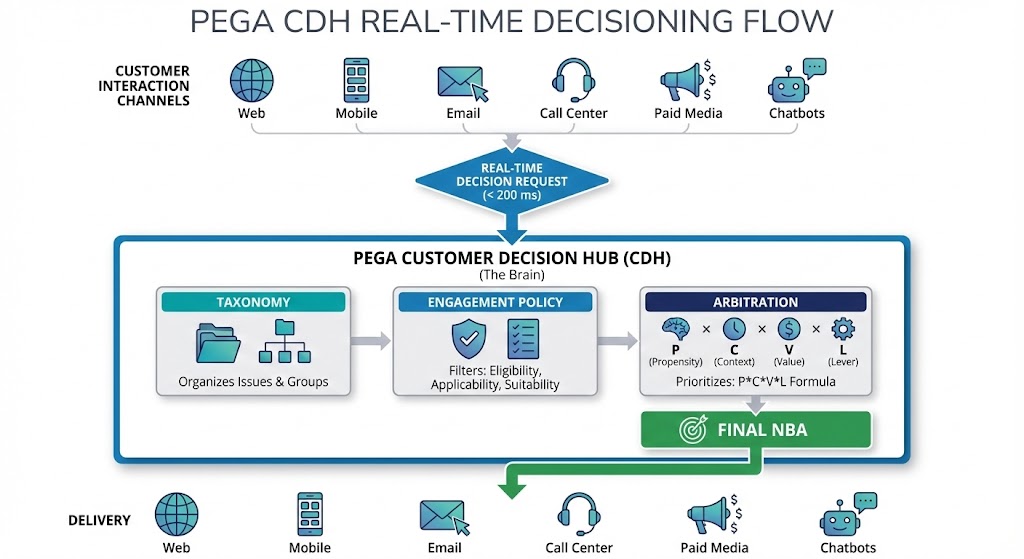
Marketing and decisioning teams are increasingly asked to convert real-time signals into measurable business outcomes — without increasing technical debt. The Decision Funnel is the operational framework that turns disparate signals into a predictable flow: intake → qualify → score → arbitrate → act → learn. When implemented inside Pega Customer Decision Hub (CDH) using the Next-Best-Action Designer, that funnel becomes a repeatable, governable system that business users can manage directly.
This article translates CDH architectural logic into a diagram-ready, production-grade recipe for systematically configuring NBA using the Decision Funnel concept. It is written for dual audiences: CMOs and marketing leaders who care about outcome, and Lead Decision Architects (LDAs) who must map those outcomes to precise CDH constructs.
Architecture Breakdown — core components and business value
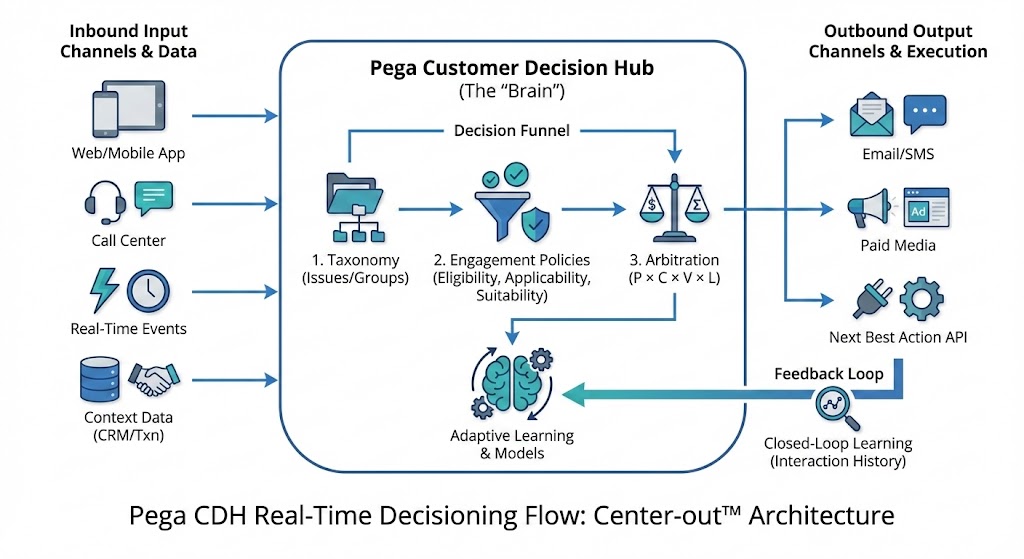
Center-out™ architecture (the organizing principle)
Definition (how it looks):
Center-out™ architecture places the decisioning core at the center and exposes decisions outward to all channels (inbound real-time, outbound batch, orchestration services). Inputs (signals, profiles, models) feed the center; outputs (actions, offers, content) are pushed outward. The architecture emphasizes a single truth for propensity and arbitration while enabling channel-specific execution.
Strategic Insight:
Center-out™ reduces fragmentation. For a CMO, it means consistent experience and measurement across channels. For an LDA, it centralises decision logic, reducing duplicated models and inconsistent rules.
Why This Matters for CMOs and LDAs
- CMOs: consistent messaging, single measurement across journeys → better attribution and CX coherence.
- LDAs: single decision source reduces replication, simplifies governance and audit trails.
Taxonomy: Issues & Groups (decision organization)
Definition (how it works):
Taxonomy is the CDH construct that organizes offered Issues (business intents or propositions) into logical Groups (collections used for arbitration and sequencing). Taxonomy maps to the Decision Funnel stages — e.g., Awareness, Offer, Retention, Service — and ties each action to a business intent and KPI.
Strategic Insight:
A clearly defined taxonomy enables business users to reason about priorities at the issue level rather than at scattered campaigns. CMOs get better portfolio visibility; LDAs can map taxonomy to strategy (eligibility, routing, KPI tracking).
Why This Matters for CMOs and LDAs
- CMOs: see portfolio balance (growth vs. retention) and remove competing actions across channels.
- LDAs: enables reuse (same Issue applied to many Channels) and deterministic arbitration scopes.
Constraints (communication limits and guardrails)
Definition (how it works):
Constraints are explicit rules—frequency caps, channel conflicts, do-not-disturb windows, consent states—enforced before actions are presented. Constraints prevent over-contact and regulatory breaches.
Strategic Insight:
Constraints protect customer experience and legal compliance; they translate high-level policies (e.g., “max 3 promotional touches/week”) into enforceable runtime checks that the business can manage.
Why This Matters for CMOs and LDAs
- CMOs: risk mitigation and CX preservation; maintain brand trust.
- LDAs: operationalize legal and business rules so arbitration only considers valid, non-conflicting actions.
Engagement Policy (Eligibility, Applicability, Suitability)
Definition (how it works):
Engagement Policy is the set of rule layers that filter candidate actions:
- Eligibility — static and profile-based gates (e.g., product ownership, KYC).
- Applicability — contextual gates (channel capabilities, time, device).
- Suitability — customer state and propensity alignment (is this message right now?).
Each layer reduces the candidate set before arbitration.
Strategic Insight:
Engagement Policy converts business constraints into deterministic filters. CMOs get predictable campaign reach estimates; LDAs minimize runtime complexity by pruning early.
Why This Matters for CMOs and LDAs
- CMOs: tighter control of who sees what; more predictable KPIs.
- LDAs: reduced ML model load and faster decision latency because ineligible candidates are removed early.
Arbitration (priority = propensity × context × value × lever)
Definition (how it works):
Arbitration ranks the remaining candidate actions and selects the one (or ordered set) to present. The canonical CDH scoring concept used here is:
Score Action =P × C × V × L
Where:
- P = Propensity (behavioral or modelled probability of desired outcome).
- C = Context weight (recency, channel fit, customer context).
- V = Business value (LTV impact, margin, strategic KPI).
- L = Lever (operational levers: offer depth, discount caps, volume limits).
Arbitration can be further normalized or thresholded for policy reasons. This is the Key. Not everyone is doing:
NormalizedScore= (P×C×V×L) /max(P×C×V×L)
Strategic Insight:
Arbitration makes tradeoffs explicit. CMOs can set business value and lever priorities; LDAs control how propensity and context interact — enabling business-driven, yet technically precise prioritization.
Why This Matters for CMOs and LDAs
- CMOs: directly tie financial or strategic value into runtime decisions.
- LDAs: reproducible, auditable scoring formula that supports A/B testing and explainability.
Channels: Inbound Real-Time, Outbound Batch
Definition (how it works):
Distinguish processing modes and their runtime characteristics:
- Inbound Real-Time — decisions executed synchronously in a user session or event stream (high velocity, low latency). Interacts with Real-Time Container for quick retrieval and scoring.
- Outbound Batch — list generation and aggregated segmentation for scheduled sends (bulk scoring, heavier enrichment allowed).
Strategic Insight:
Differentiate channel capabilities to align the Decision Funnel: use real-time for contextual micro-moments and batch for planned programs. CMOs can design distinct KPIs per mode; LDAs must ensure models and taxonomy are available in both containers.
Why This Matters for CMOs and LDAs
- CMOs: match engagement tactics to channel strengths (e.g., time-sensitive offers in real-time).
- LDAs: manage model deployment and data latency across containers to preserve decision quality.
Next-Best-Action Designer (business user control plane)
Definition (how it works):
Next-Best-Action Designer is the guided, low-code interface inside CDH where business users define and manage NBA artefacts: Taxonomy, Constraints, Engagement Policy, Arbitration parameters, and Channel mappings. It abstracts technical complexity while exposing the knobs (value weights, levers, eligibility rules) that matter to marketing.
Strategic Insight:
By placing strategy controls in a business-facing designer, organizations shorten the feedback loop: marketers iterate on offers and levers without full IT cycles. This is the practical interface that operationalises the Decision Funnel.
Why This Matters for CMOs and LDAs
- CMOs: faster campaign adjustments, fewer handoffs, improved agility.
- LDAs: preserves governance while enabling business agility — reduces tactical change backlog.
Closed-loop learning (behavior-driven propensity shifts)
Definition (how it works):
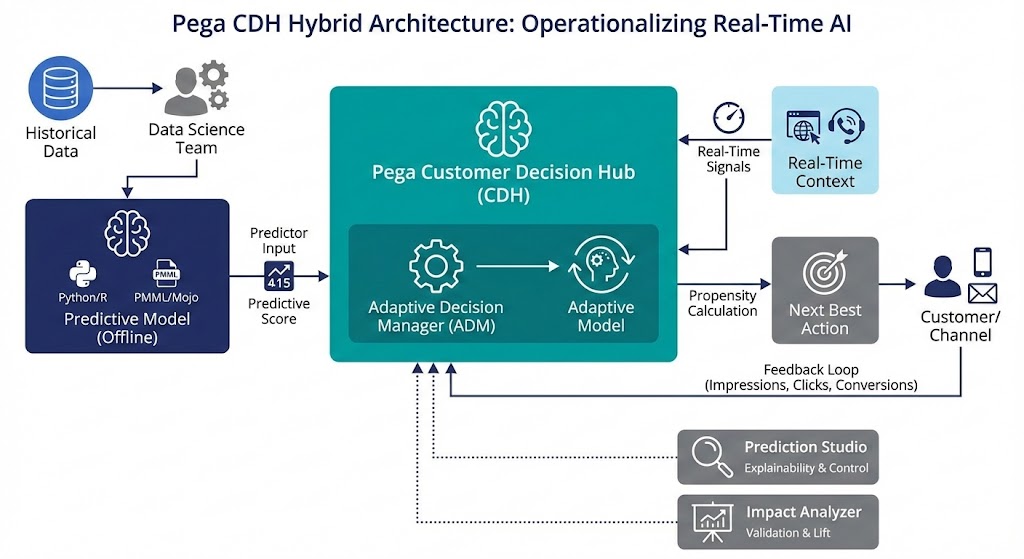
Closed-loop learning captures outcomes (clicks, conversions, complaints) and feeds them back to propensity models and context weights, enabling the system to shift scores based on actual behavior rather than static assumptions. This is essential for production resilience and drift correction.
Strategic Insight:
Learning closes the gap between predicted and real outcomes, directly improving ROI over time. Business teams can measure lift and update V and L accordingly.
Why This Matters for CMOs and LDAs
- CMOs: continuous improvement of spend efficiency and personalization accuracy.
- LDAs: enables model retraining cadence, monitoring for data drift, and safer model promotion to production.
Production-grade CDH architecture (inputs, processing, outputs, feedback)
Definition (how it works):
A production architecture explicitly separates responsibilities:
- Inputs: profile, transaction, event stream, model outputs, consent state.
- Processing: Engagement Policy filtering → Arbitration scoring → Constraints enforcement.
- Outputs: channel payloads, audit trails, KPI events.
- Feedback: outcome ingestion for closed-loop learning and reporting.
Strategic Insight:
Production readiness is not optional; it requires engineering the funnel with observability, fallback logic, and policy enforcement so business owners can trust runtime decisions.
Why This Matters for CMOs and LDAs
- CMOs: predictable, auditable outcomes and the ability to scale campaigns.
- LDAs: clear separation of concerns simplifies scaling, reduces downstream incidents, and makes compliance auditable.
Real-World Application — Step-by-step Decision Funnel implementation (strictly aligned to the provided Business Context)
This section maps the Decision Funnel into a repeatable configuration sequence inside Pega CDH using Next-Best-Action Designer. It assumes the explicit goal: Systematically configure NBA using Decision Funnel concept.
Step 1 → Define the Decision Funnel stages (Taxonomy mapping)
- Create Groups corresponding to funnel stages: Intake, Qualification, Engagement, Conversion, Retention.
- Define Issues (concrete actions/offers) and map each Issue to a specific Group.
Strategic Insight:
Mapping the funnel to Taxonomy ensures every action has a business intent and a KPI owner, making measurement and rollback straightforward.
Step 2 → Encode Constraints (guardrails)
- Authorize contact frequency, channel-specific caps, consent checks, and suppression lists in the Constraints layer.
- Implement hard constraints (lawful bases, opt-outs) and soft constraints (brand fatigue thresholds).
Strategic Insight:
Constraints translate brand policy into runtime safety nets, preserving long-term customer value.
Step 3 → Configure Engagement Policy per funnel stage
- For each Group, define Eligibility (who can receive), Applicability (where it can run), Suitability (when it’s appropriate).
- Example flow:
- Qualification Group
- Eligibility = customer has not already converted;
- Applicability = inbound web or call channel;
- Suitability = high propensity but low recent engagement.
- Qualification Group
Strategic Insight:
Early policy gates reduce noise and increase meaningful touches, improving downstream conversion efficiency.
Step 4 → Define and tune Arbitration formula
- Set the arbitration formula as:
Score Action = P × C × V × L
- Assign initial weights:
- Propensity from models (daily retrain cadence).
- Context weights for recency and channel fit.
- Business value matrix from finance (LTV, margin).
- Levers from marketing (max discount, priority boosts).
Strategic Insight:
By exposing each factor in Next-Best-Action Designer, marketing can reweight priorities (e.g., temporarily boost retention offers during a campaign) without code changes.
Step 5 → Map channels and processing modes
- Real-Time (Inbound):
- Attach the Decision Funnel to the Real-Time Container for sub-second decisions.
- Ensure lightweight context enrichment and propensity retrieval (cache or fast model calls).
- Batch (Outbound):
- Use scheduled scoring pipelines fed by the same Taxonomy and Engagement Policies; enrich heavily and export lists for execution.
Strategic Insight:
Consistent taxonomy and arbitration across containers ensures channel parity; different operational constraints drive the choice of container.
Step 6 → Deploy via Next-Best-Action Designer (business user empowerment)
- Publish the Taxonomy, Engagement Policy, and Arbitration knobs to business users through the Designer.
- Use the Designer to simulate reach and projected KPIs before publishing.
Strategic Insight:
The Designer shortens the time from idea → publish, enabling marketing experiments to move at market speed while remaining governed.
Step 7 → Monitor outcomes and close the loop
- Capture outcome events (accept, decline, complaint) as decision events.
- Feed outcomes to propensity model training pipelines and update context weights and levers.
Strategic Insight:
Closed-loop learning ensures the Decision Funnel evolves with customer behavior rather than becoming stale.
Closing – What this delivers?
When you systematically configure NBA with a Decision Funnel inside Pega CDH and expose controls via Next-Best-Action Designer, you convert strategic priorities into governed, testable runtime behavior. CMOs gain agility and measurable ROI through controlled experimentation and consistent cross-channel experience. LDAs gain a repeatable, auditable architecture with clearly separated concerns: policy, scoring, execution, and learning.
The result is a production-grade decisioning system that is both business-driven and technically rigorous – exactly what organizations need to scale personalization without sacrificing governance or speed.