The Strategic Imperative: Beyond the “Megaphone” Approach
For decades, enterprise marketing has relied on a foundational inefficiency: the segment-based campaign. This “one-size-fits-all” methodology functions largely as a megaphone, blasting product-centric messages to broad demographics. The result is statistically grim. As noted in industry benchmarks, this approach typically yields response rates below 1%—a 99% failure rate that signals not just indifference, but active customer disengagement.
The challenge lies in the architecture of the interaction. Traditional campaigns are siloed, rigid, and disconnected from the customer’s immediate context. To solve this, organizations must migrate to Pega Customer Decision Hub (CDH) and its Next-Best-Action (NBA) paradigm. This is not merely a software upgrade; it is an architectural inversion from product-centric “push” to customer-centric “pull,” leveraging real-time AI to ensure relevance, empathy, and consistency.
1. Why Segment-Based Campaigning Fails in Modern Engagement
Traditional segment-driven marketing attempts to predict “who might care” rather than understanding what this individual needs right now. This structural limitation drives several enterprise-scale challenges.
Core Business Challenges of Segment-Based Marketing
1. Irrelevant Messages and Low Response Rates
Segments generalize. Customers don’t.
This mismatch leads to high-volume pushes with extremely low resonance—visible in typical campaign response rates under 1%.
Strategic Insight:
CMOs gain immediate efficiency by eliminating wasted impressions; LDAs reduce operational overhead by removing complex segment logic that must be manually refreshed.
2. Product-Centric, Not Customer-Centric
Segment campaigns prioritize what the enterprise wants to push, not what the customer needs. This product-first bias ignores individual context such as intent, life events, or channel preference.
Strategic Insight:
CMOs unlock higher lifetime value by aligning offers to customer intent; LDAs use consistent Taxonomy, Contexts, and Engagement Policies to encode that alignment.
3. Siloed Channels and Fragmented Experiences
Segments generate channel-specific lists, resulting in inconsistent messaging across paid, owned, and physical channels.
Strategic Insight:
CMOs achieve brand coherence; LDAs leverage Real-Time Containers, NBA Channels, and Outbound Schedulers to deliver the same next best action everywhere.
4. Static Decisioning in a Dynamic Customer Journey
Segments are evaluated monthly or quarterly—completely misaligned with customer behavior that changes by the second.
Strategic Insight:
Real-time decisioning replaces batch-only logic, allowing LDAs to operationalize continuous, context-aware arbitration.
2. How Pega CDH Replaces Segments With 1:1 Empathetic Decisioning
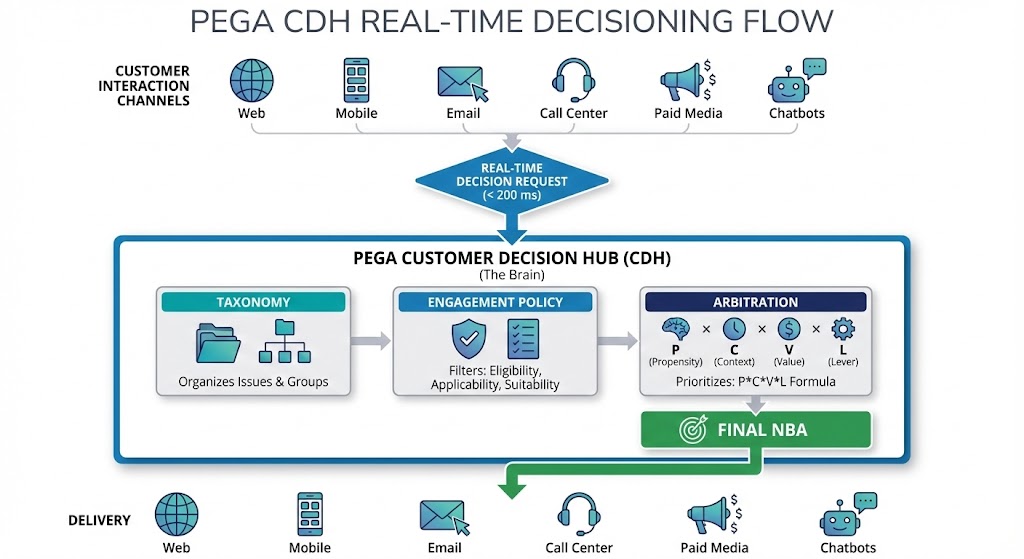
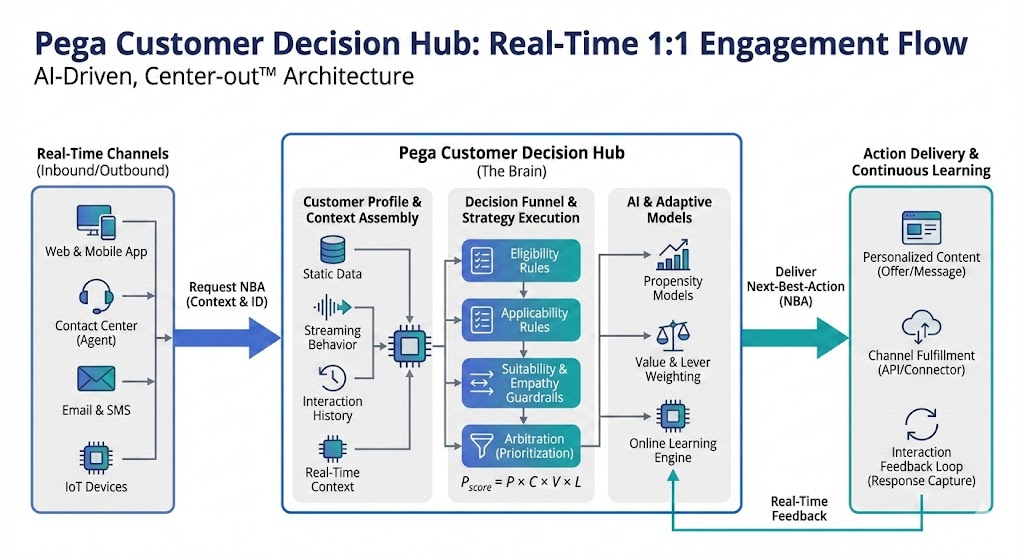
Pega’s Center-out™ architecture shifts from “who do we target?” to “what is the best action for this individual right now?” using four core components.
Component 1: AI-Driven Propensity Modeling
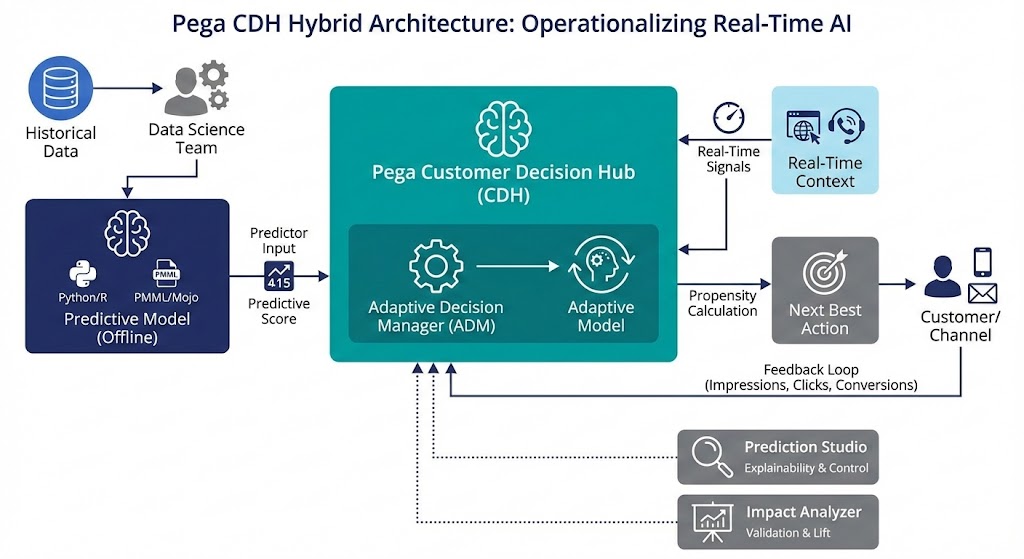
Pega evaluates each customer in real-time using adaptive and predictive models to calculate Propensity, a key input into arbitration.
Formula — Propensity Contribution
In arbitration, the customer’s likelihood of responding is computed as:
Score= P × C × V × L
Where:
- P = Propensity
- C = Customer Context
- V = Value
- L = Business Levers (e.g., weight boosting for strategic priorities)
Strategic Insight:
CMOs move from generic broadcast to mathematically optimized relevance; LDAs maintain transparency through Predictor Bins, Model Scores, and Simulation Data.
Component 2: Engagement Policies
Engagement policies ensure qualification, applicability, and suitability before any action is considered.
Policy Types
- Eligibility (hard business rules)
- Applicability (contextual logic)
- Suitability (customer-centric and risk controls)
Strategic Insight:
CMOs reduce risk and improve trust; LDAs create scalable governance guardrails across actions and groups.
Component 3: Arbitration Engine
Pega’s arbitration logic ranks all available actions based on customer context, balancing organizational goals with customer needs.
Arbitration Inputs
- Propensity (AI likelihood)
- Context Weighting
- Business Value
- Action Constraints
- Channel Availability
Strategic Insight:
CMOs ensure the customer receives the right message, not simply the most profitable one; LDAs gain deterministic, testable logic for governance and auditability.
Component 4: Always-On Real-Time Decisioning
Pega re-evaluates the Next Best Action at every interaction, across all channels, in <200 ms.
What This Enables
- True 1:1 personalization
- Instant re-decisioning
- Channel-consistent conversations
- Orchestrated journeys across inbound and outbound
Strategic Insight:
CMOs shift from episodic campaigns to continuous engagement; LDAs operationalize a unified decisioning layer across real-time and batch channels.
3. Real-World Application: Transforming “One-Size-Fits-All” Into 1:1 Relevance
Below is a diagram-ready narrative flow using your business context:
“One-size-fits-all segment-based campaigns → 1:1 personalized messaging.”
Step-by-Step Operational Flow
Step 1 – Customer Enters the Ecosystem
The customer takes an action (web visit, app login, contact center call)
Input: Customer profile, historical behavior, interaction context.
Step 2 – CDH Evaluates Eligibility & Suitability
The Engagement Policy filters out irrelevant or inappropriate actions.
Outcome: Only contextually viable actions remain.
Step 3 – AI Models Calculate Propensity
Adaptive and predictive models compute the real-time likelihood of acceptance for each remaining action.
Step 4 – Arbitration Ranks the Actions
CDH calculates the composite score:
NBA=max(P×C×V×L)NBA = \max(P \times C \times V \times L)NBA=max(P×C×V×L)
The highest-scoring action becomes the Next Best Action.
Step 5 – Channel Delivers the Action
Inbound or outbound channels (owned, paid, digital, or physical) deliver the action with consistent messaging.
Step 6 – Customer Response Feeds the Brain
Each interaction—click, ignore, decline—feeds back into adaptive models, improving next interactions.
Strategic Insight:
CMOs see immediate gains in CTR and conversion (as seen in CTR improvements from 0.16% → 4.1%). LDAs see reduced complexity and scalable governance with fewer segments and more centrally managed actions.
4. Why CDH Is the Backbone of Modern Personalization?
Organizations attempting to scale personalization beyond segments inevitably hit operational and architectural limits.
Pega CDH removes those constraints by providing:
- A unified decisioning layer
- Real-time arbitration
- Channel-consistent personalization
- Continuous learning
- Balance between customer needs and business priorities
This is how enterprises migrate from mass campaigns to continuous, empathetic, one-to-one engagement—improving relevance, boosting conversion, and deepening customer relationships at scale.