Imagine you have a friend. Let’s call him “Brand.”
Every time you meet Brand for coffee, he introduces himself as if he’s never met you before. He tells you the same stories. He tries to sell you insurance while you’re crying about a breakup. He promises to meet you at the cinema but goes to the park instead.
You wouldn’t stay friends with Brand for very long.
According to the Customer Experience Trends Report , this is exactly how most enterprises are treating their customers right now. Despite all our shiny MarTech tools, sentiment is trending negative. Why? Because brands are acting like amnesiacs—disjointed, slow, and lacking empathy.
For CMOs and Lead Decision Architects, the goal for 2026 isn’t just “better software.” It’s building a centralized brain. Here is how we take the pain points from this week’s report and solve them using Pega Customer Decision Hub (CDH).
Customers Aren’t Asking for Better AI. They’re Asking to Be Remembered.
If you’ve ever had to repeat your problem to three different support agents, you already understand why customer experience is breaking.
You start hopeful.
You end tired—and ready to leave.
That feeling shows up again and again in this week’s Customer Experience Trends report. Customers aren’t angry because brands lack technology. They’re frustrated because brands don’t seem to know them, remember them, or act in their best interest.
Despite chatbots, CRMs, and “personalisation engines,” experience quality is declining. For many organisations, the problem isn’t effort – it’s how decisions are made.
And that’s where the story really begins.
The Real CX Problem: Brands React. Customers Feel It.
Most organisations don’t fail customers intentionally. They fail them structurally.
Think of a large airport.
Every team is doing its job:
- Check-in is optimised
- Security is staffed
- Boarding is automated
Yet passengers still miss flights because no one orchestrates the whole journey.
Customer experience works the same way.
Marketing sends messages.
Service handles issues.
Digital teams design flows.
But customers experience one journey, not three departments.
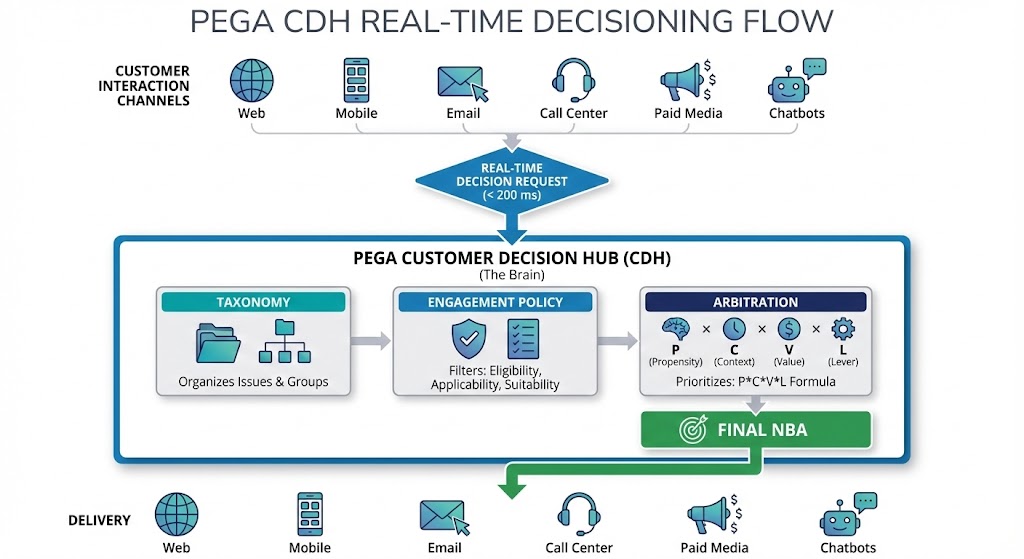
Pega Customer Decision Hub changes this by acting like the air traffic controller – constantly deciding what should happen next, based on who the customer is and what’s happening right now.
When Support Is Slow, Customers Don’t Complain. They Leave.
Picture this:
You contact support about a billing issue.
You wait.
You explain.
You get transferred.
You explain again.
By the time someone helps, your patience is gone—and so is your loyalty.
This isn’t a staffing issue. It’s a decision delay.
With Pega Customer Decision Hub, brands can:
- See the full customer context instantly
- Recognise urgency, value, and frustration in real time
- Guide agents with the next best action, not a script
Instead of asking:
“Which queue does this go into?”
The system asks:
“What should we do now to fix this and keep the customer?”
That shift—from routing to resolving—is what customers feel as “good service.”
Repeating Yourself Is the Fastest Way to Lose Trust
Nothing breaks confidence faster than hearing:
“Can you explain that again?”
Customers don’t mind sharing information.
They mind sharing it again and again.
This happens when systems don’t talk—and when decisions don’t travel with the customer.
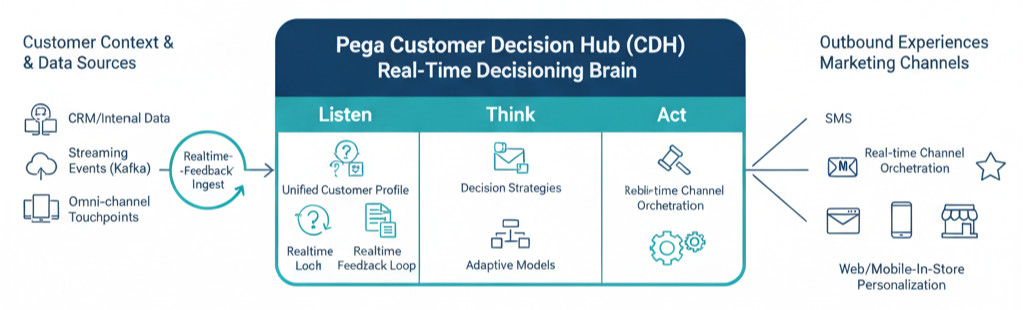
Pega CDH keeps the memory of the relationship alive:
- What the customer tried online
- What they said to the chatbot
- What the agent already knows
So when the channel changes, the conversation doesn’t reset.
From the customer’s perspective, it feels simple:
“They already know what’s going on.”
From the organisation’s perspective, it’s decision orchestration working quietly in the background.
AI Isn’t the Problem. Emotionless AI Is.
Customers don’t hate chatbots.
They hate being trapped by them.
We’ve all been there:
- The bot repeats itself
- The answer doesn’t fit
- There’s no clear way out
The issue isn’t automation. It’s automation without judgment.
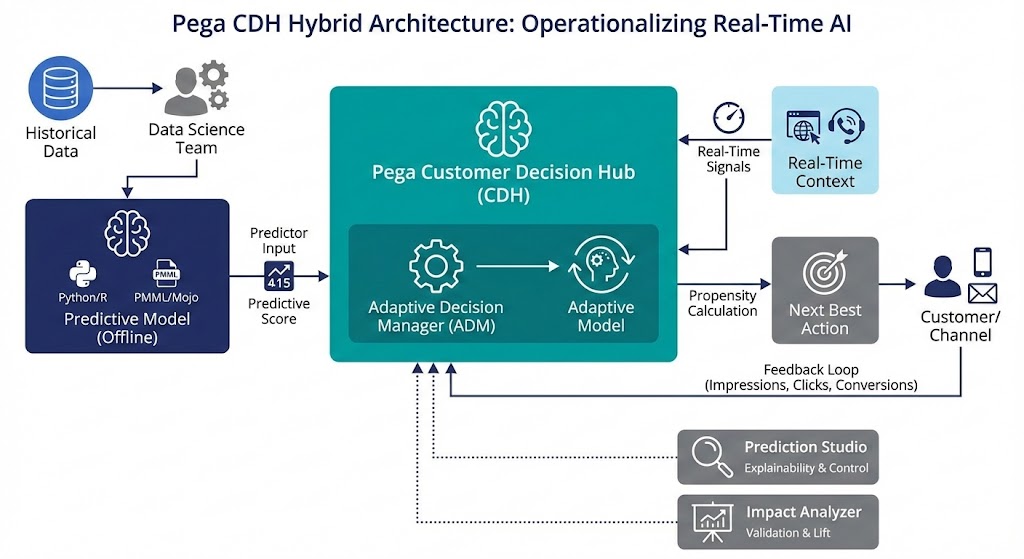
Pega CDH uses AI to decide:
- When automation helps
- When a human should step in
- What that human needs to know immediately
It’s like a good assistant who says:
“This one needs a real conversation.”
That’s how AI stops feeling cold – and starts feeling helpful.
Onboarding Should Feel Like a Welcome, Not an Obstacle Course
First impressions matter.
Yet many onboarding journeys feel like:
- Too many steps
- Too much confusion
- Too little guidance
Customers don’t drop off because they’re uninterested.
They drop off because the journey doesn’t adapt.
Pega CDH treats onboarding like a conversation, not a checklist:
- If a customer hesitates, the journey adjusts
- If they struggle, support appears
- If they succeed, momentum continues
The experience feels smoother—not because it’s shorter, but because it’s smarter.
Personalisation Isn’t About Knowing More. It’s About Acting Better.
Customers say they want personalisation—but only when it feels respectful.
They don’t want:
- Random offers
- Poor timing
- Messages that feel “creepy”
They do want:
- Relevance
- Transparency
- Value when it matters
Pega CDH makes personalisation decision-led:
- What is helpful right now?
- What builds trust?
- What should we not say yet?
That’s how loyalty shifts from points and discounts to genuine value.
Why This Matters Now
Customer experience isn’t declining because brands don’t care.
It’s declining because decisions are fragmented.
The organisations that win next won’t be the ones with the most tools.
They’ll be the ones that consistently make better decisions in real time.
Pega Customer Decision Hub doesn’t replace marketing, service, or digital teams.
It connects them—so customers feel one brand, one journey, one relationship.
And in a world where trust is fragile, that consistency is everything.
Pega Customer Decision Hub is not another MarTech tool.
It is the decisioning layer that turns CX into a growth engine.
- One customer view
- One decision brain
- One consistent experience
Right action. Right customer. Right moment.
Want to Learn & master Pega Customer Decision Hub & implementation best practies, contact us